The Montessori Approach
‘Help me to do it by myself’ is the motto often associated with the Montessori approach. When children’s emerging independence is fostered through a favourable environment, they become happy and calm. It is amazing what they can achieve when their desire to ‘let me do it’ is facilitated.
Video of child dressing Fun Shoe and Coat Tricks for Toddler and Preschooler Independence – Living Montessori Now
Maria Montessori
‘Never let a child risk failure until he has a reasonable chance of success’
Maria Montessori, born in 1870, was Italy’s first woman doctor. She had a particular genius for observing children as they really are rather than as adults wish them to be. By observing children in a scientific manner and without the usual preconceived educational ideas, she was able to create new techniques of education which emphasised the ‘unique’ development of each child. This led to the Montessori system which has at its core an environment in which the child is free to develop his/her own skills and abilities. She advocated that all children are intrinsically motivated to learn and that they absorb knowledge without effort when provided with the right kind of activities at the right time of their development. The goal of early childhood education should not be to fill the child with facts from a preselected course of studies but rather to cultivate her/his own natural desire to learn.
In the classroom this objective is approached in two ways, first by allowing each child to experience the excitement of learning by her/his own choice, and second, by helping them to perfect all their natural faculties for learning, so that their ability will be at a maximum in future learning situations. Each child is able to progress at his/her own pace and encouraged to follow their own path of development. The child is not pressured to achieve.
How the children learn
In her writings Maria Montessori continually referred to the ‘absorbent mind’. The child’s mind literally absorbs information from the environment. The process is particularly evident in the way a two year old learns his native language. Without formal instruction children acquire information naturally.
Since children retain this ability to learn by absorbing until they are almost seven years old, Maria Montessori reasoned that their experience could be enriched by a classroom where they could handle materials which would impart basic educational information to them. Young children can learn to read, write and calculate in the same natural way that they learn to walk and talk. So the equipment in a Montessori classroom is designed to allow the child to reinforce her/his casual impressions. It invites the child to use his/her hands for learning.
The entire programme of learning is structured. Children can begin the basic exercises at two years old and progress to equipment which will help them to develop concentration and co-ordination. It is a unique cycle of learning designed to take advantage of the child’s ‘sensitive years’ when they can absorb information more easily from an enriched environment. By pursuing her/his individual interests in a Montessori classroom, the child’s own drive to enquire and explore motivates the learning process, develops self-discipline and unconscious learning.
Montessori materials are used in all areas of the curriculum and equate with The Early Years Foundation Stage (EYFS)
Communication and Language
Sharing experiences and thoughts is encouraged by the staff who listen to children one to one, in small groups and during whole group circle times. Staff take account of what children say and will endeavour to develop their ideas through provision of appropriate activities. Staff are aware of their role in developing the language skills of the children and will take time to talk clearly, rephrasing for children when necessary. We have participated in various schemes that raise awareness of this important area of development such as I CAN and TALK TOGETHER.
Personal, Social and Emotional Development
Learning to socialise is crucial for young children and this will be the main area of learning when your child is at nursery. Being able to cope away from main carers is a major step in a child’s life and this is supported by our caring staff. Each child has a ‘key teacher’ who they will form an attachment with. We encourage turn taking, sharing, learning how to respond when things don’t go according to plan. We celebrate children’s successes as well as giving support to overcome difficulties, so enabling children to grow in confidence in a safe and nurturing environment.
Physical Development
The safe and independent use of equipment both indoors and outside in the playground and garden encourage confidence and self-assurance. By allowing children to imitate the everyday tasks carried out by adults they learn to perfect their co-ordination and lengthen their span of concentration. For example The Dressing Frames enable the child to perfect each separate skill of dressing, doing up buttons, tying shoe laces or using zips. Each of the Sensorial Materials isolates one defining quality such as colour, weight, shape, texture, size, sound or smell.
Literacy
In the Montessori classroom children learn to read and write by performing a series of purposefully structured activities. With the Sandpaper Letters they learn alphabetical symbols and phonetic sounds. They develop pencil control by having a wide range of mark making possibilities and specifically using the Insets for Design. When children are ready they can make phonetic words with the Large Moveable Alphabet from which reading and writing spontaneously develop.
Mathematics
The Montessori Sensorial materials provide a wealth of experiences for children to explore size, shape, weight and simple maths concepts such as pairing and one to one correspondence. For example, the Wooden Tower, a series of ten graded cubes, introduces the child to graduation in size. Children gain a good understanding of quantity and symbols 0-10 through use of concrete materials such as the Large Number Rods and Sandpaper Numerals.
Understanding the World
We are committed to extending children’s awareness of caring for the environment, we do this by instilling a love of nature by being out in the garden, caring for plants and animals and appreciating the awe and wonder of the natural world. We also involve children in recycling and understanding conservation through simple measures like not wasting water or other resources. We have a selection of materials through which children can further their understanding of the World. These include simple science experiments, special puzzles that identify the parts of plants and animals, globes, not to mention our seasonal displays of natural treasures!
Expressive Arts and Design
Creativity is fundamental to successful learning and develops most productively within a rich learning environment, one where they are given time to explore and develop ideas and finish their work in their own time. We have a wide range of activities that enable children to respond by using their senses. Through music, art, dance, role-play and imaginative play children’s creativity, originality and expressiveness are valued.
The Montessori Classroom
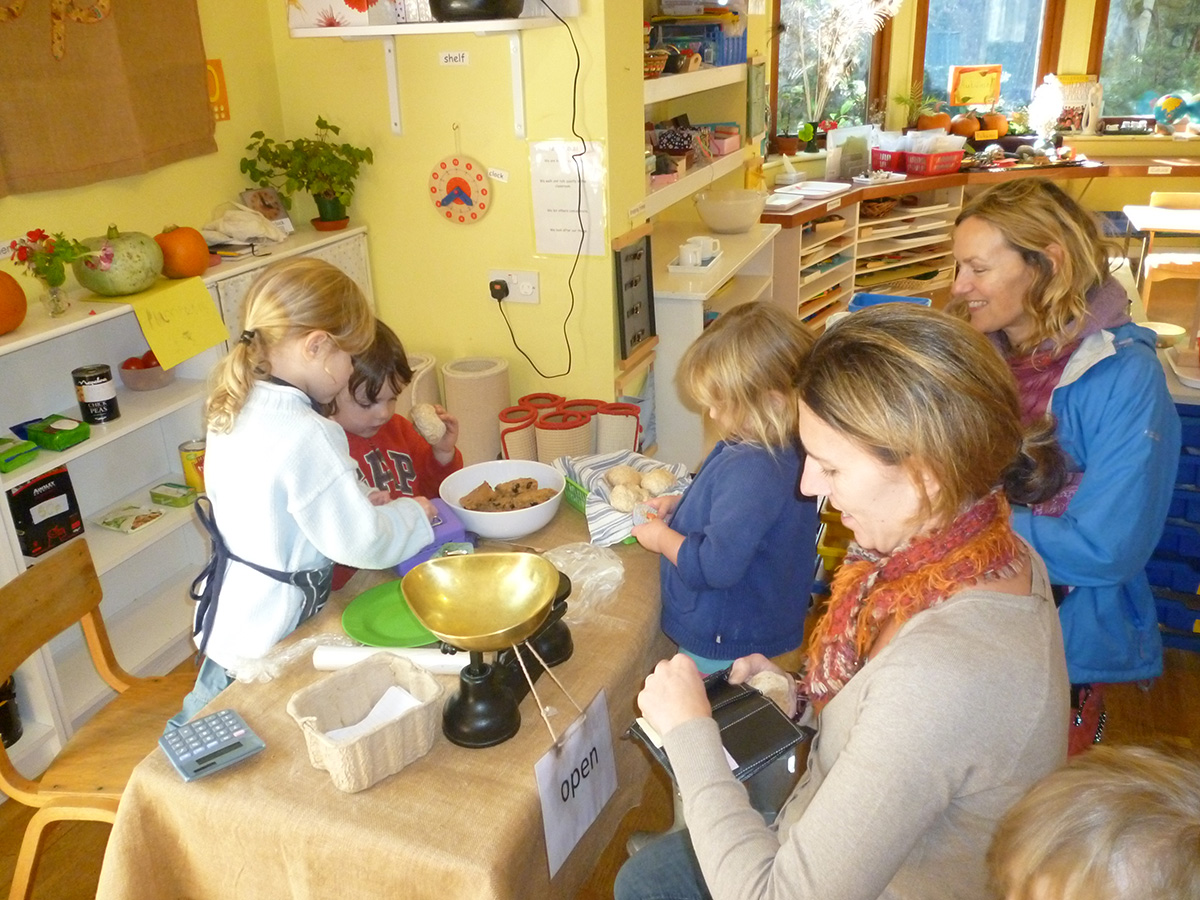
Everything in the classroom is child sized with all the activities within reach to allow free choice. It is a child’s world, designed to put children at ease by giving them freedom in an environment prepared with attractive materials. The classroom is guided by a ‘teacher’ who observes the individual interests of each child, demonstrates the use of materials and carefully monitors the progress of each child. The classroom is a busy place as the activities involve walking, carrying, pouring, speaking and the constant handling of materials. Self- direction is acquired by absorption in meaningful activities.
‘Montessori’ children work individually and in small groups, as well as regularly with a teacher. Co-operation and social skills are constantly emphasised.
It is a well-established fact the pre-school children mature at very different rates and their periods of readiness for academic subjects vary a great deal. Because interest is stimulated and the materials are at hand whenever a child is ready, some children in a Montessori class begin to read and calculate at an early age. However, very early learning is not the objective of the system.
Individual activities are supplemented with other activities such as music appreciation, group singing, gardening, creative art and craft, music and movement, games and play.
Maria Montessori’s ideal was that the learning experience should occur naturally and joyfully at the right moment for each individual child. She once wrote ‘we cannot make a genius, we can only give each individual the chance to fulfil his or her potential to become an independent, secure and balanced human being’. At the Chagford Montessori Nursery School we aim to do this to the best of our ability.
Each year we have parents who decide to defer their child’s entry to Primary School by either one/two or three terms. As children are not required to start school until the term after their fifth birthday some children stay on for the whole of the school ‘Reception year’ and start school entering Year 1. This enables children to complete the whole of their ‘Foundation Stage’ in one setting and being one of the older children can increase their confidence before they make the transition to school. The Early Years Educational Entitlement (EYEE) can be claimed up to and including the term in which the child is five.
After Montessori?
The habits and skills which a child develops in a Montessori classroom are good for a lifetime. Given the right conditions children will learn to work efficiently, observe carefully and concentrate effectively wherever they go. If children are in a stimulating environment, whether at home or school, their self-education will continue.
In order to facilitate the transfer from the nursery to primary school we have a good relationship with all the local schools. The primary school teachers are invited to visit us and the children visit the primary schools for several ‘settle in’ sessions prior to them leaving us.